CHOOSING YOUR AVALANCHE SHOVEL
AVALANCHE SHOVEL: THE IMPORTANCE OF A SUITABLE MODEL
Did you know that you can save 5 to 10 times less time in an avalanche rescue with a shovel compared to without one? Every second is crucial in such a situation. Often chosen without much consideration for its features, the avalanche shovel is a crucial ally in freeing a victim from an avalanche. However, not all models are equal, and not all of them are suitable for you (based on your weight, height, whether you are left or right-handed, etc.).
On average, the time to free an avalanche victim is 11 minutes with complete and suitable equipment (transceiver, shovel, probe) compared to 25 minutes with only a transceiver and shovel, or over 60 minutes with only a transceiver. The chances of the victim's survival are 91% during the first 18 minutes and decrease significantly afterward. Efficient shoveling techniques are crucial!
Therefore, it is essential to choose your avalanche shovel wisely and to be familiar with effective shoveling techniques. If that is your intention, you are in the right place!
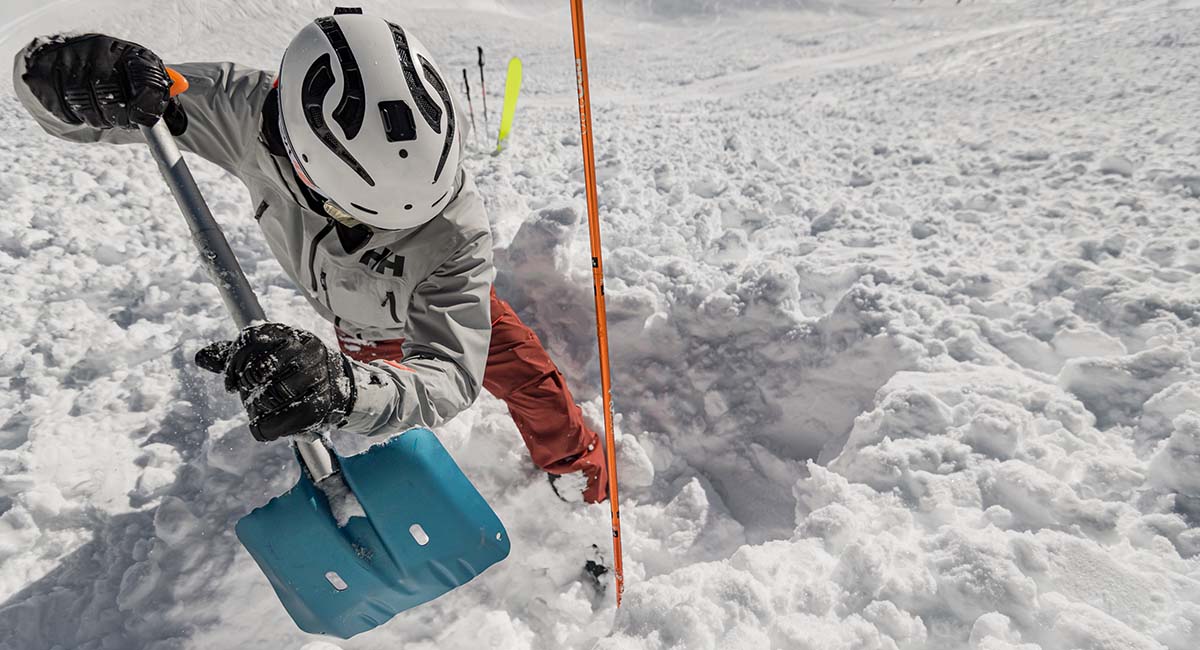
HOW TO CHOOSE THE RIGHT AVALANCHE SHOVEL
OPT FOR A TELESCOPIC AND OVAL HANDLE
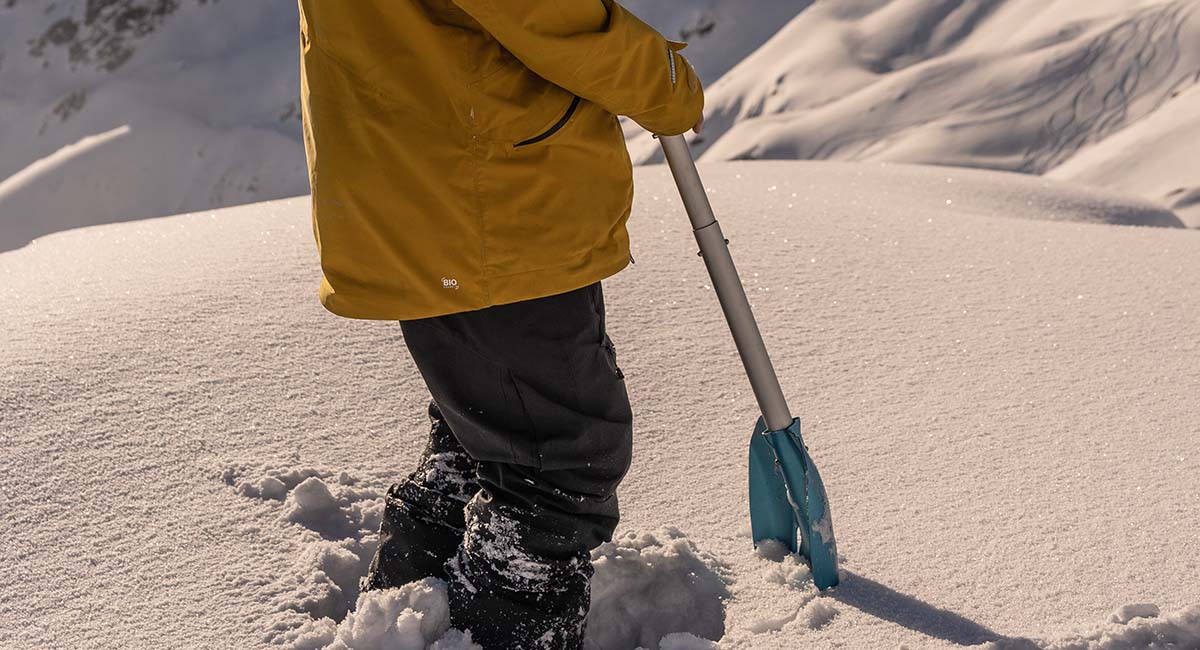
In addition to comfort, being able to adjust the length of the telescopic handle allows adaptation to the type of snow encountered and for an effective two-stage rescue. A longer length for the initial shoveling clears large volumes of snow initially. A shorter handle length later allows more precision when approaching the victim. Similarly, if the snow is particularly hard, a shorter handle length makes the task easier.
An oval section handle ensures more intuitive adjustment than a round handle, as well as more rigidity. An ovoid handle ensures that you are in line when folding or unfolding the handle.
THE IMPORTANCE OF AN ERGONOMIC HANDLE
The handle of your avalanche shovel should have a medium diameter for a good grip. The ergonomics and materials of the handle should also provide an effective grip. T-shaped handles have the advantage of being compact in your backpack and comfortable.
Specific Handles for Specific Uses
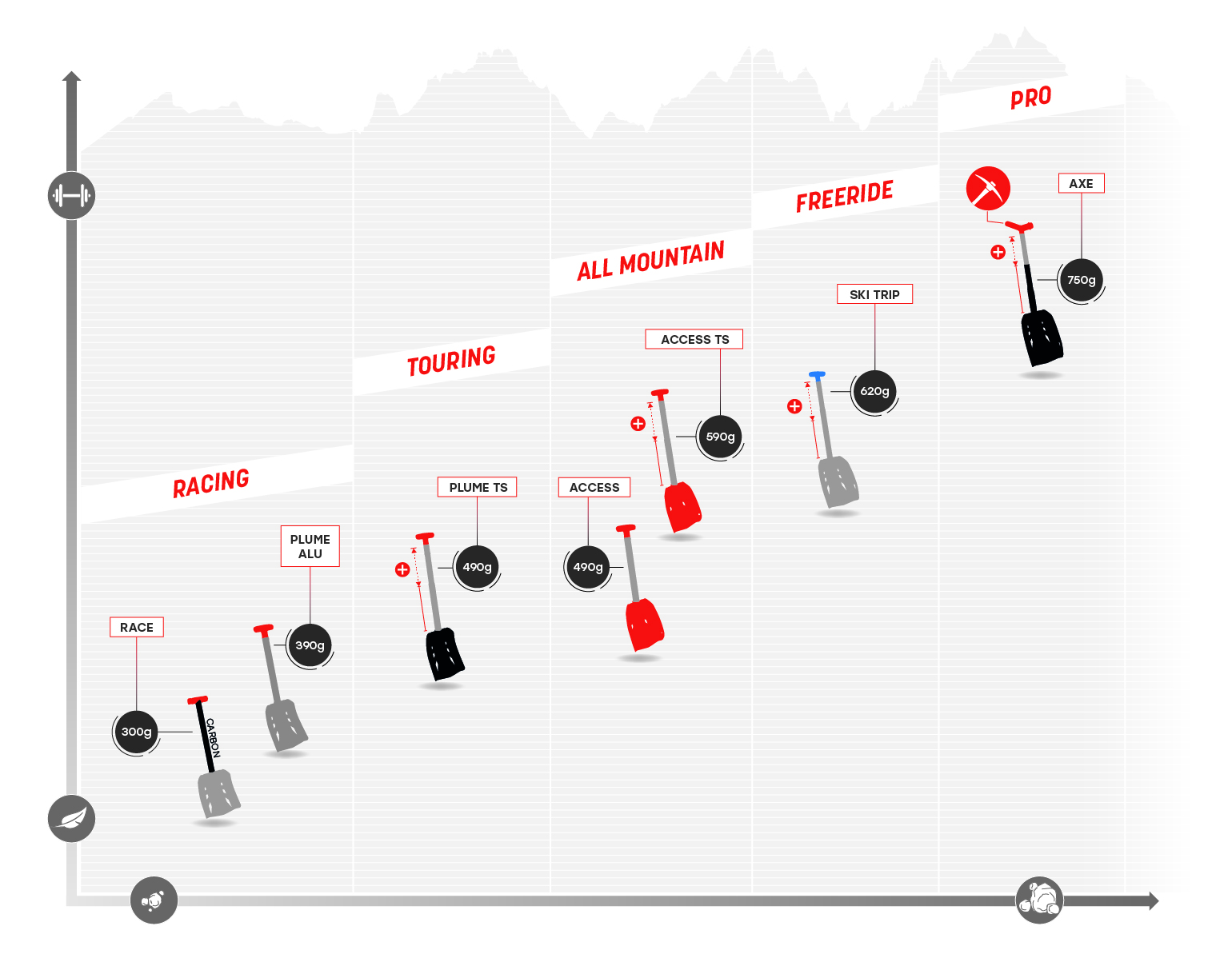
Some specific handles can meet particular needs. For example, the Y-shaped handle of our Axe shovel allows it to be converted into a pick for even more efficiency. The Pro shovel, on the other hand, has a reinforced D-shaped handle, considered the most ergonomic type of handle.
THE SCOOP: SIDE EDGES, SHARP BLADE, AND OPTIMIZED VOLUME
A scoop with relatively high edges ensures that the snow stays in the shovel when digging and does not escape on the sides. A sharp leading edge allows your shovel to penetrate the hard surface of avalanche snow. In terms of volume, a shovel with a lot of volume allows you to clear a larger quantity of snow, but this can quickly become counterproductive as it becomes too heavy and difficult to carry.
Option: the Scoop Convertible into a Pick
Facing hard snow, a shovel convertible into a pick can be particularly effective. Some scoops allow this conversion, such as the one on our Axe shovel, for example.
FOR A STURDY SHOVEL, USE STURDY MATERIALS!
Most of our shovels are made of high-quality aluminum, ensuring unwavering reliability, especially at the scoop level. To gain lightness, some handles are made of carbon, which is less rigid. This is especially the case for shovels used in ski mountaineering competitions, for example, when avalanche risk is controlled.
COMPARISON OF OUR ARVA AVALANCHE SHOVELS
Sounding Techniques
Once the victim is located with your avalanche probe, identify the burial depth. Take this distance and multiply it by 1.5: position yourself at this distance from the victim, downstream. Make sure to leave the probe in place.
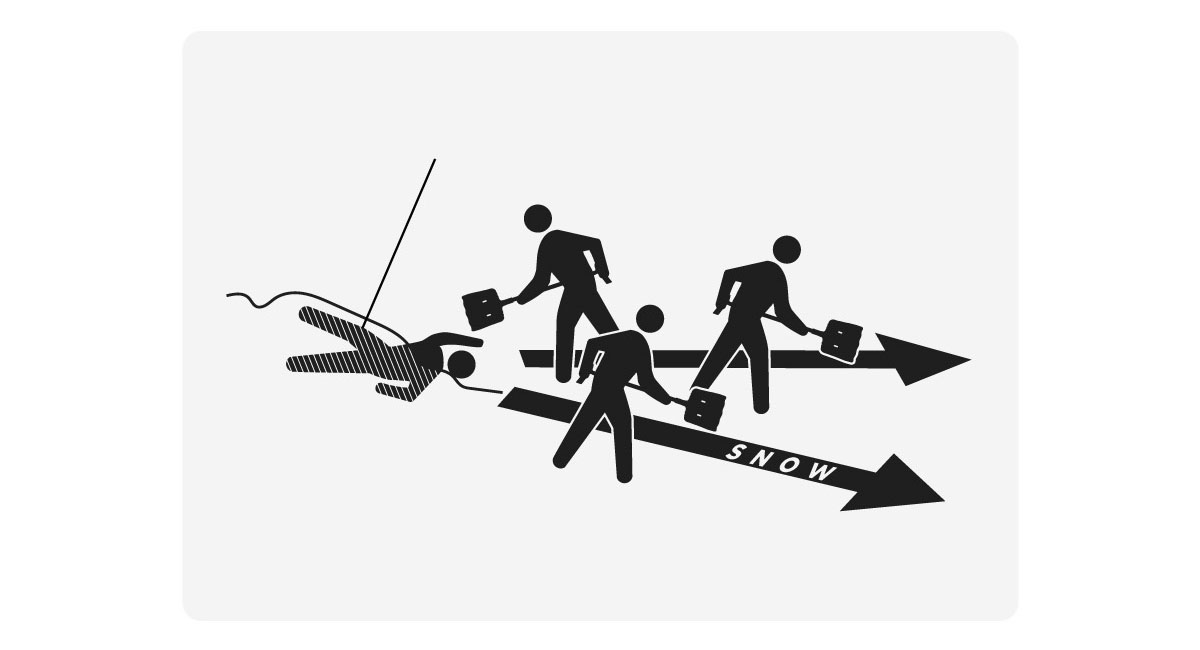
In the first shoveling phase, remove as many snow blocks as possible. If several people are involved, form a V, with one person digging at the front and two people at the back. Clear the snow in a conveyor belt fashion to move it downward. If necessary, feel free to use the pick function, which can be very effective.
Remember to take turns, as the position closest to the victim is also the most physically demanding.
Find our online avalanche safety training program and learn rescue techniques.


